
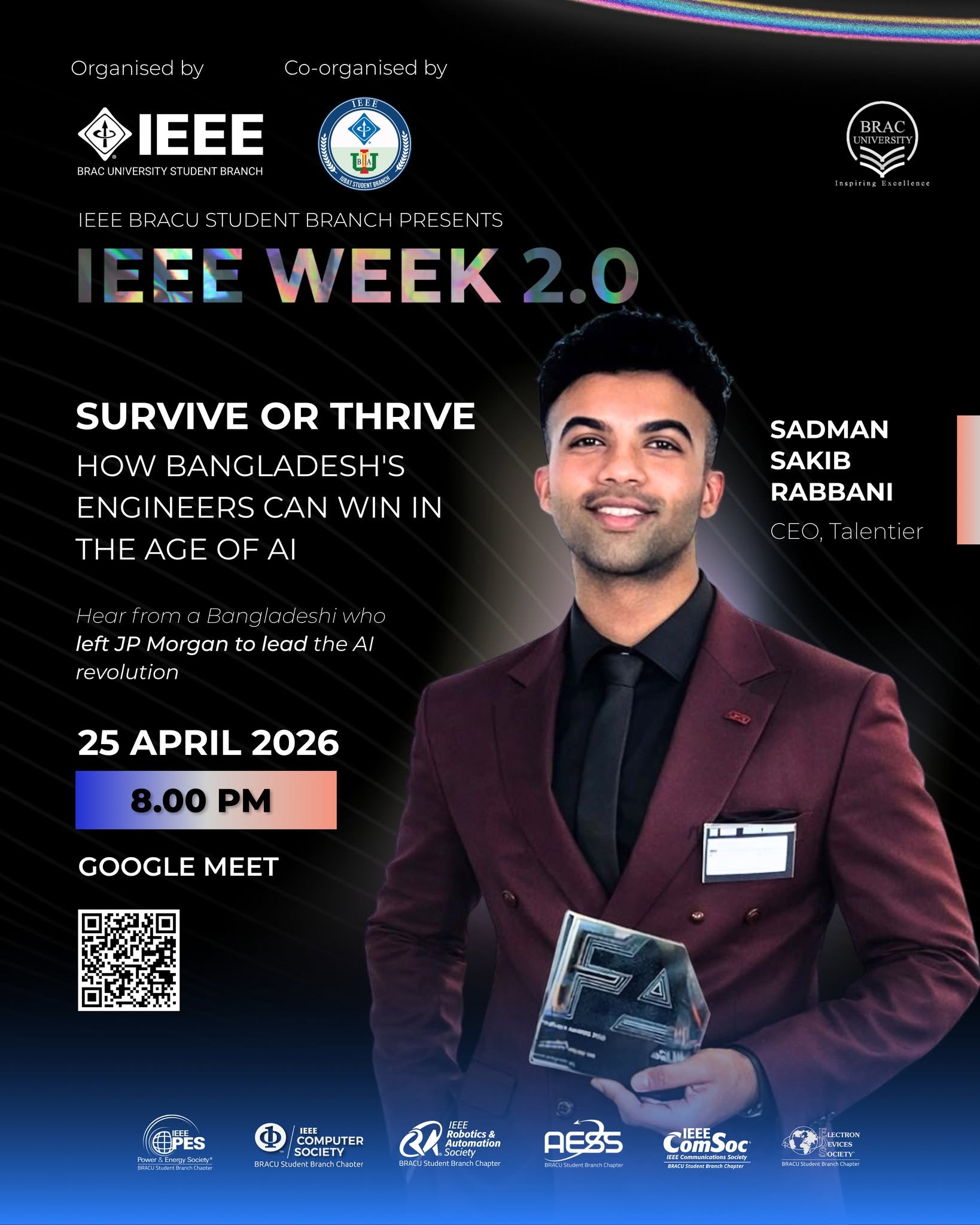
IEEE BRAC University Student Branch, in collaboration with the IEEE IUBAT Student Branch,
successfully organized and concluded the webinar “Survive or Thrive: How Bangladesh’s
Engineers Can Win in the Age of AI” on 25th April 2026 at 8:00 PM via Google Meet. The session
was designed to provide students and young engineers with a clear understanding of how artificial
intelligence is reshaping the engineering landscape, and what it takes to remain competitive and
relevant in this rapidly evolving era.
The session was conducted by Sakib Rabbani, CEO & CTO of Talentier, a one-stop marketplace for
startups that supports growth from MVP to large-scale deployment. With a strong background in
fintech, AI-driven systems, and startup acceleration, he has gained international recognition through
multiple prestigious awards and programs. His ventures have been acknowledged in global
competitions such as the HKICT Awards, Fintech Trailblazers, and the Bank of China Challenge, and
he has been associated with renowned platforms including Cyberport, HSBC, and HKTDC. His
experience across global innovation ecosystems positioned him as a highly relevant speaker for a session
focused on the future of engineering and AI.
Throughout the webinar, Sakib Rabbani delivered a highly engaging and interactive session,
maintaining continuous communication with participants and encouraging real-time responses,
reflections, and discussions. He began by sharing his personal journey, offering insights into how he
transitioned through different roles and built expertise across technology, business, and innovation.
This provided participants with a relatable and practical perspective on career growth in a competitive
global environment.
The session then moved into a discussion on AI fundamentals and the global landscape, where he
explained how different regions are approaching AI development and what this means for emerging
economies. He highlighted that the AI race is not uniform, but shaped by different priorities across
countries. Building on this, he addressed the reality of AI in Bangladesh, focusing on both the
challenges and opportunities, and emphasizing the need for smart adoption rather than imitation.
A significant portion of the discussion focused on engineering employment and entrepreneurship,
where he explained how traditional career paths are evolving and how engineers must now think
beyond technical expertise alone. He emphasized the importance of networking, emotional
intelligence (EQ), adaptability, and strategic thinking, highlighting that these human-centric
skills are becoming increasingly important alongside technical knowledge. He also demonstrated
practical applications through examples and live demonstrations, helping participants understand how
AI tools can be used effectively in real-world scenarios.
The session included a dedicated segment on myth-busting, where common misconceptions about
AI replacing jobs or eliminating the need for human input were addressed. Instead, he reframed AI as a
tool that amplifies capability when used correctly. To ensure that participants could apply their
learning beyond the session, he also introduced a practical action-oriented checklist, guiding
students on how to take immediate steps toward building relevant skills and positioning themselves for
future opportunities.
To further encourage engagement, the session incorporated a performance-based recognition system.
The top 10 most actively engaged participants were selected for an exclusive one-on-one call with
the speaker, providing them with direct mentorship and guidance. Additionally, the top 3
participants were offered internship interview opportunities, creating a direct pathway from learning
to potential career advancement. All participants who remained until the end of the session received a
30-day action checklist, reinforcing the practical and outcome-driven nature of the webinar.
The event concluded with an interactive question-and-answer session, where participants asked
thoughtful and relevant questions regarding AI applications, career strategies, and future
opportunities. The discussion reflected a high level of enthusiasm and engagement, with students
actively seeking to connect the insights from the session to their own academic and professional paths.
Overall, the webinar was highly impactful, successfully combining global perspective, practical
knowledge, and interactive engagement. It not only enhanced participants’ understanding of AI and its
implications but also provided clear direction on how to navigate the changing landscape of
engineering careers. IEEE BRAC University Student Branch expresses sincere gratitude to the speaker for his valuable contributions, to the IEEE IUBAT Student Branch for their collaboration, and to all
participants for their active involvement. The success of this event reinforces the commitment to
organizing more such meaningful and forward-looking initiatives in the future