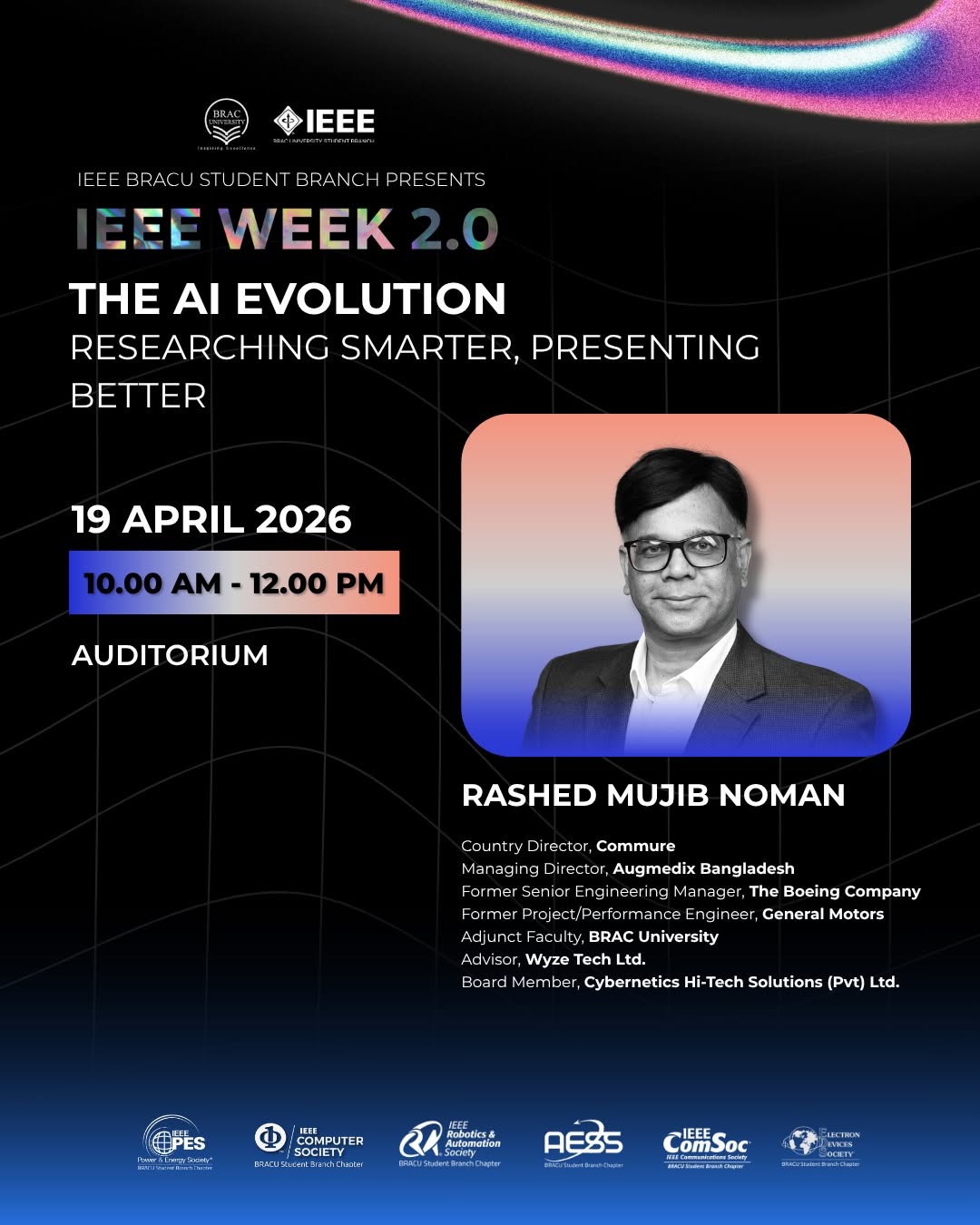
IEEE BRAC University Student Branch successfully organized the masterclass “The AI Evolution:
Researching Smarter, Presenting Better” on 19th April 2026 at the BRAC University Auditorium
from 10:30AM-12:00PM as part of IEEE Week 2026. The session was designed to help students
understand how artificial intelligence can be used not only as a tool for efficiency, but as a means to
enhance the way they think, research, and communicate.
The session was led by Rashed Mujib Noman, Country Director at Commure and Managing
Director of Augmedix Bangladesh, who brings extensive global experience across engineering, AI
systems, and academia. Having previously worked in key engineering roles at organizations such as The
Boeing Company and General Motors, alongside his role as an Adjunct Faculty member at BRAC
University, he offered a well-rounded perspective connecting industry, research, and education.
During his session, he emphasized the critical difference between simply using AI and using it
effectively. He highlighted how many users rely on AI for quick outputs, often accepting responses at
face value, whereas effective use requires strategic prompting, verification, iteration, and treating AI as a
thinking partner. He introduced the CAPE framework (Context, Assumptions, Push Back, Expand &
Narrow) as a structured method for conducting research using AI. Through this, he demonstrated
how providing proper context, questioning assumptions, critically evaluating outputs, and refining
results can significantly improve the quality of work.
He also discussed practical applications of AI for engineering students, including accelerating literature
reviews, simplifying complex technical concepts, and using AI as a collaborative problem-solving
partner. A significant portion of the session focused on how AI can be used to improve presentations,
where he outlined a structured workflow starting from building a clear narrative, ensuring one key idea
per slide, and using AI to identify the core message within data. He emphasized anticipating audience
questions and refining communication to make technical content more impactful and accessible. He further introduced a simple yet effective presentation framework based on defining the problem,
presenting the solution, highlighting measurable impact, and ending with a clear action point.
Beyond tools and techniques, he highlighted the broader skillset required for future engineers, stressing
the importance of problem formulation, critical thinking, adaptability, and clear communication. He
reinforced that while AI can significantly enhance productivity, fundamental engineering principles,
ethical judgment, and curiosity remain essential.
The session also featured Special Guest Speaker Zubair Ahmed Quazi, a Silicon Valley-based
technologist, entrepreneur, and investor with professional experience at organizations such as
JPMorgan, VMware, and Yahoo. In his segment on “Global Artificial Intelligence Race vs
Bangladesh,” he provided a broader global perspective on how different regions are approaching AI
development. He explained that the AI race is not a single unified competition, but rather multiple
parallel priorities, where the United States and China focus on power and dominance, Europe
emphasizes regulation and governance, and India leverages scale and population advantage.
Positioning Bangladesh within this context, he emphasized that the country’s path should focus on
smart adoption and workforce transformation. He outlined a strategic vision for 2036, where
Bangladesh could become a leading AI-enabled services exporter, build a workforce of one million
AI-skilled professionals, and integrate AI across key sectors, generating significant economic value. He
summarized this with the statement: “Silicon Valley builds intelligence. Bangladesh scales its
execution.” His talk connected global technological trends with practical national opportunities,
offering a forward-looking perspective for students.
The event concluded with an interactive question-and-answer session, where participants actively
engaged with both speakers. Students raised insightful questions regarding the practical use of AI
tools, career preparation, and future opportunities in an evolving technological landscape. The
discussion allowed for deeper clarification of key concepts and reflected strong enthusiasm and
participation from the audience.
Overall, the session was highly impactful, combining technical depth with practical relevance and
strategic insight. IEEE BRAC University Student Branch expresses sincere gratitude to the speakers for
their valuable contributions and to all participants for their active engagement. The success of this
event reinforces the commitment to organizing more such meaningful and forward-thinking initiatives
in the future.