
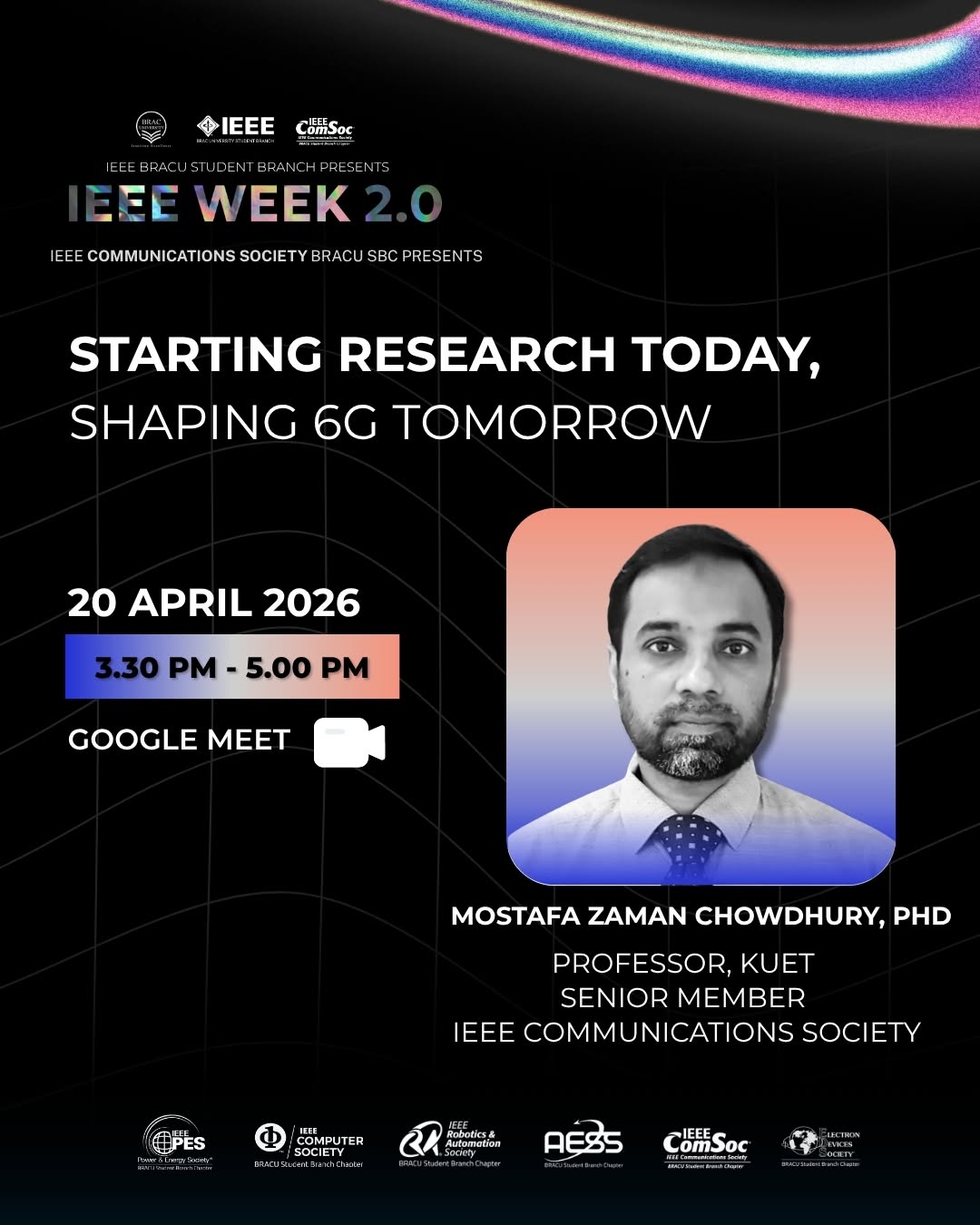
On 20th April 2026, Monday, 3:30 PM, the IEEE Communications Society BRAC University
Student Branch Chapter organized an insightful webinar titled “Starting Research Today,
Shaping 6G Tomorrow.” The event focused on two main topics: the future of 6G
communication and the basics of scientific research. The webinar attracted many students who
were interested in research, wireless communication, and future technologies.
The event started smoothly with a short introduction about IEEE and the ComSoc student
branch. The host welcomed the participants and gave a brief idea about the topic of the webinar.
The session was designed to help students understand both advanced technology and how to start
research properly.
The keynote speaker of the webinar was Dr. Mostafa Zaman Chowdhury, Professor of
Electrical and Electronic Engineering at KUET.
He is a well-known researcher in wireless communication and has strong experience in 5G and
future networks.
Session Overview
Session on 6G Communication
The session began with a discussion on the evolution of mobile communication from 1G to 6G.
The speaker explained how each generation improved communication systems and added new
features. He showed that 6G is the next step to meet future demands.
He explained that the main motivation for 6G is the rapid growth of data and new technologies
like AI, virtual reality, and autonomous systems. Current 5G technology is not enough to handle
future needs.
Some of the main goals of 6G are to provide extremely fast data speeds, reaching up to 1 Tbps,
so that downloading, streaming, and communication can happen almost instantly. Another
important goal is ultra-low latency, around 1 millisecond, which means there will be almost no
delay during communication, making real-time applications smoother and more reliable. The
speaker also mentioned global connectivity, where people from remote and rural areas will be
able to access the internet just as easily as those in big cities. Along with this, 6G focuses on high
energy efficiency so that future networks consume less power and remain environmentally
sustainable. Finally, intelligent communication using AI will help networks automatically
manage traffic, reduce problems, and provide a smarter and more seamless user experience.
The speaker also discussed several key technologies that are expected to enable the development
of 6G communication systems. These include Artificial Intelligence (AI), which will allow
networks to become more intelligent and self-optimizing; Terahertz (THz) communication,
offering extremely high data transmission speeds; and optical wireless communication such as
Li-Fi, which uses light for faster and more secure connectivity. The concept of intelligent
reflecting surfaces was introduced as a way to improve signal coverage and efficiency by
controlling wireless environments. In addition, satellite and drone-based networks, known as 3D
networking, will extend connectivity to remote and hard-to-reach areas. Quantum
communication was also highlighted for its potential to provide highly secure data transmission.
Together, these technologies aim to build a fully smart and interconnected world where devices,
systems, and people remain seamlessly connected.
He also discussed several real-life applications of 6G technology, including smart healthcare
systems that enable remote monitoring and advanced medical services, autonomous vehicles
capable of safe and intelligent transportation, and robotics and automation that can enhance
industrial efficiency and daily life activities. The speaker highlighted the role of virtual and
extended reality in creating immersive experiences for education, entertainment, and remote
collaboration. In addition, the concept of the Internet of Everything (IoE) was presented, where
devices, people, data, and processes are all interconnected. The session clearly demonstrated that
6G will not only enhance communication speed and capacity but will fundamentally transform
how people live, work, and interact with technology in the future.
Session on Scientific Research
In the second part, the speaker focused on how to start research and write a good research paper.
This part was very helpful for students who want to work in research.
He explained that a strong research paper should clearly answer four important questions. First, it
should explain what the researcher actually did in the study. Second, it needs to describe why the
research was conducted and what problem or motivation led to the work. Third, the paper should
show how the research was carried out, including the methods, tools, or approaches used.
Finally, it must present what was achieved from the research, highlighting the results, findings,
or contributions made through the study.
He also explained the main parts of a research paper and their purposes. The title gives a clear
idea about the topic of the research. The abstract provides a short summary of the entire study,
including the objective, method, and key findings. The introduction explains the background of
the problem and why the research is important. The methodology section describes how the
research was conducted and what techniques or tools were used. The results and discussion
section presents the findings and explains their significance. The conclusion summarizes the
overall outcomes of the study and suggests possible future work. Finally, the references section
lists all the sources and previous studies that were used to support the research.
The speaker emphasized that research work should always include something new or valuable.
This could be a new method or idea, improved performance compared to existing systems,
reduced cost or complexity, or meaningful improvement of previous research work. He explained
that research is not only about repeating existing ideas but about contributing something useful to
the field.
He also discussed some common mistakes students often make while writing research papers.
These include writing without having a clear understanding of the topic, poor formatting that
makes the paper difficult to read, and incorrect or missing references. He advised students to
study the topic properly, follow standard formatting guidelines, and maintain accurate
referencing to ensure the quality and credibility of their research work.
Publication Ethics and Guidelines
Another important part of the session focused on research ethics. The speaker stressed that
honesty and originality are the foundation of good research. He explained that only those who
have genuinely contributed to the work should be included as authors. Students were advised to
strictly avoid plagiarism and always acknowledge other researchers’ work through proper
citation. He also warned against using fake, incomplete, or incorrect references, as these damage
the credibility of both the paper and the researcher. In addition, the speaker introduced journal
quality and indexing systems such as SCI, SCIE, and Scopus, explaining why they are important
for publishing research papers and how they help measure the standard and impact of academic
research.
Q&A Session and Evaluation
After the main session, an interactive Q&A session was conducted. The participants asked
different questions about 6G technology, research topics, and future opportunities. The speaker
answered all the questions clearly and helped students understand the concepts better. This part
made the session more engaging and useful for everyone.
To evaluate the participants’ understanding, an MCQ exam was also arranged after the webinar.
The questions were based on the topics discussed during the session.
Based on the exam results:
- The top three scorers were selected as winners.
- These top three participants will receive hard copy certificates as a recognition of their performance.
- All other participants will receive a certificate of participation for attending the webinar.
This initiative encouraged active participation and helped students test their knowledge from the session.
Conclusion
The webinar was very informative and useful for students. It provided both technical knowledge
about 6G and practical guidance on how to start research.
The session helped students understand future communication systems and encouraged them to
explore research opportunities. It also showed the importance of ethics, proper writing, and clear
thinking in research work.
Overall, the event was successful and inspired many students to start their research journey and
contribute to future technologies like 6G.