
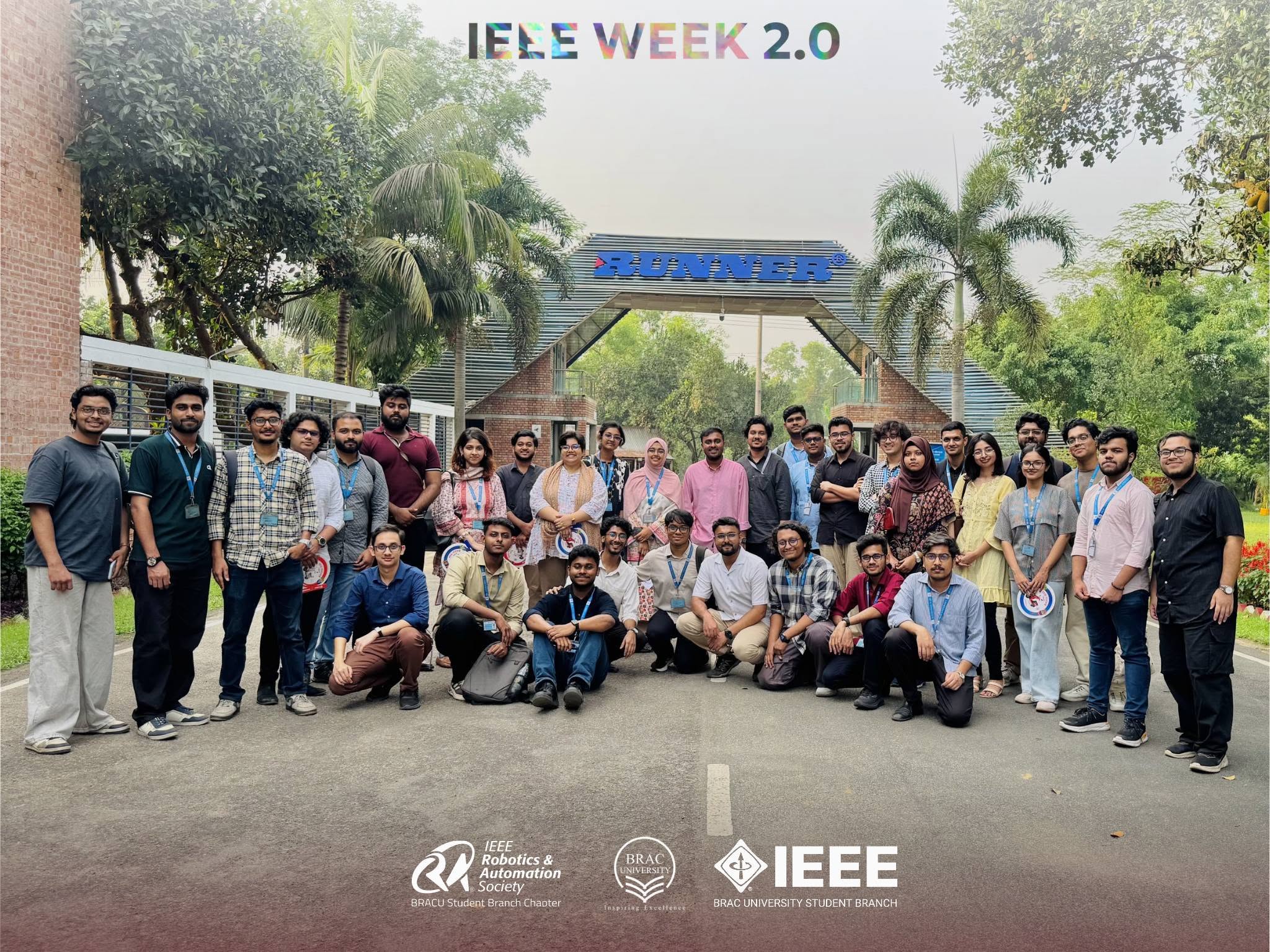
On 15 April 2026, IEEE Robotics and Automation Society BRAC University Student Branch Chapter
organized an industry visit to Runner Automobiles PLC Manufacturing Plant located in Bhaluka,
Mymensingh. The visit was arranged with the aim of giving participants a practical understanding of
industrial operations, production workflows, quality control systems, workplace discipline, and the
real-life application of manufacturing and engineering concepts.
This visit created a valuable learning opportunity for the participants, as it allowed them to observe
the factory environment closely and understand how different production units work together in a
large automobile manufacturing facility.
Journey to the Industry
The journey began from the BRAC University premises at 8:10 AM. The excitement among the
participants was noticeable from the very beginning. The energy throughout the journey was very
lively, and time seemed to pass very quickly. We reached Runner Automobiles PLC Manufacturing
Plant at 10:20 AM.
Upon arrival, we were warmly welcomed by Mr. Zahidur Rahman Sir from the HR Department.
His cordial reception instantly created a positive impression and made us feel comfortable as guests of
the organization.
Introduction and Briefing Session
After reaching the premises, we first freshened up and then proceeded to the conference room for the
introductory and briefing session. This session was conducted by Plant Head, Mr. Mahboob Ali
Khan Sir and Mr. Zahidur Rahman Sir from the department of HR and Admin.
During the session, they gave us an overview of the company, the factory operations, and the activities
planned for the day. They also explained the necessary industry protocols, safety measures, and
workplace rules that we needed to follow during the observation. This session helped prepare us
mentally before entering the production area and gave us a structured understanding of what we
would be observing.
Although the regular production process was unfortunately not fully active that day due to a shortage
of materials, the visit still turned out to be highly insightful and memorable.
New Year Celebration Experience
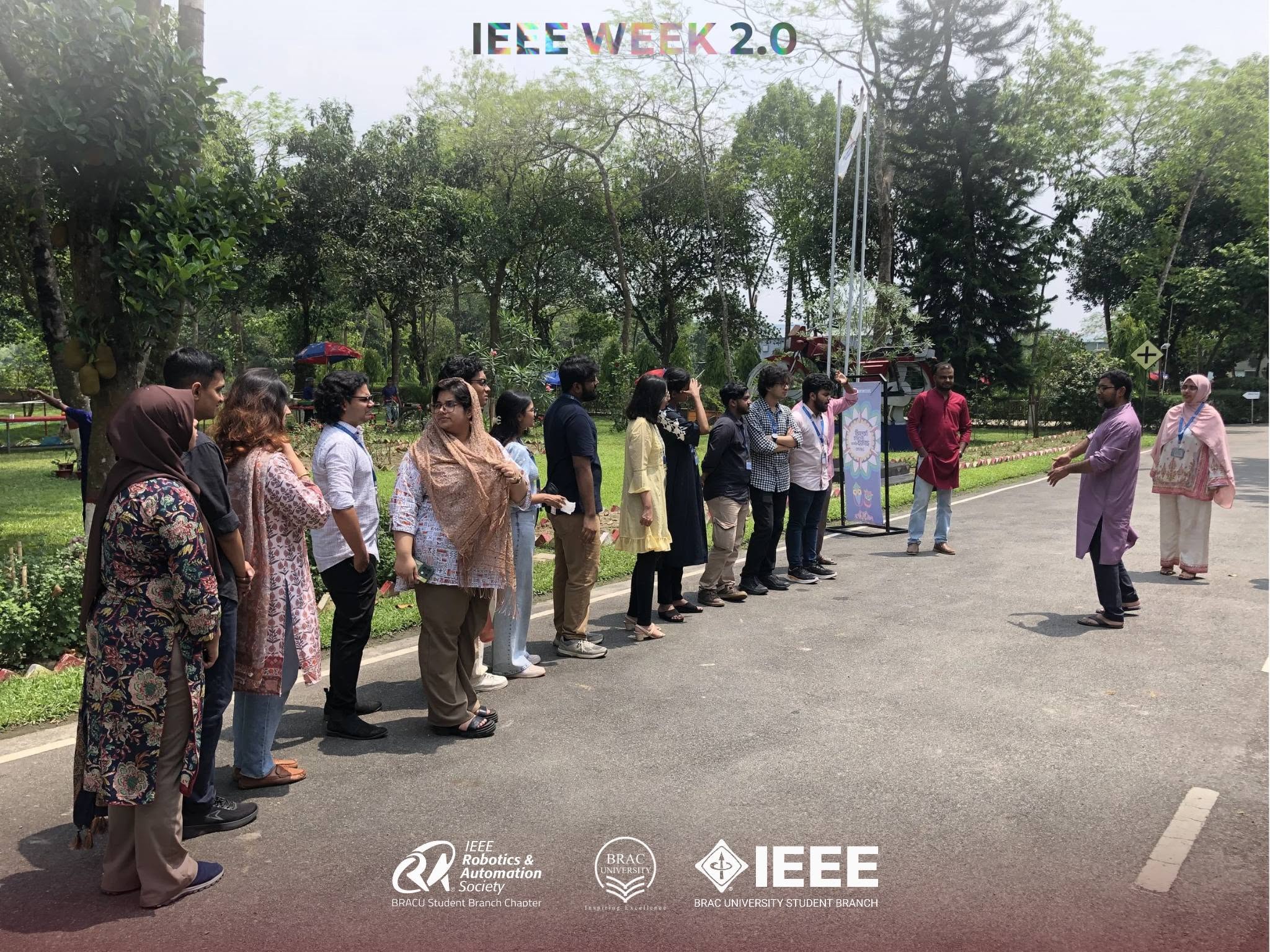
One of the most special parts of the visit was that, on the day we visited the factory, the Bengali New
Year celebration was taking place on the premises. In the front yard, a festive celebration had been
arranged with different kinds of food stalls.
The authorities of Runner Automobiles PLC Manufacturing Plant, very cordially invited us to join
them in the celebration and enjoy refreshments. This made the experience even more special, because
alongside the formal industrial exposure, we also got to witness the warm and welcoming
organizational culture of the company. We spent some time there enjoying refreshments and taking
photographs.
Factory Observation
After the refreshment session, we gathered for the main factory observation. The participants were
divided into two groups, and each group was assigned guides for proper supervision and explanation.
Our group was guided by Nijhum Ninad Sir and Amdad Shamsul Huda Sir, who helped us
understand the workflow of different sections throughout the observation.
Another very memorable part of the visit was that there was also a Malaysian student intern with us
during the factory tour. He stayed with us throughout the visit and explained many important aspects
of the factory processes in a very helpful way.
Pressing Shop
Our observation began from the 2-wheeler pressing shop. This section gave us the first direct
exposure to how raw materials are shaped into required forms. We observed that raw materials were
pressed and formed into chassis-related structures through different pressing operations.
Inside the pressing shop, we saw multiple pressing machines, along with jigs and fixtures used for
precision and support in the production process.
One of the first things I personally noticed after entering the factory was the strong emphasis on
discipline and workplace management. In every workshop we visited, there were clearly displayed
Safety Boards, 5S Workplace Boards, TPM Boards, and Quality and Defect Analysis Boards.
This showed how seriously the company maintains safety, productivity, cleanliness, quality, and
continuous improvement.
Welding Shop
After the pressing shop, we entered the welding shop. There, we observed a number of important
machines and tools, including:
- Milling machine
- MIG welding machine
- Spot welding machine
- TIG welding machine
- Turbo flame box
This section helped us understand how different welding technologies are used depending on the type
of work and material requirements.
Two-Wheeler Assembly Shop
Next, we moved to the 2-wheeler assembly shop. In this section, we observed different stages and
units involved in the assembly and testing of vehicles. Among the major areas we saw were:
- PDI
- Auto testing line
- Engine assembly line
- Vehicle assembly line
From this section, we understood that once the assembly process is completed, the products go
through quality control checking. After the QC checking is done successfully, the products are
prepared for delivery as final goods.
We also saw UDT vehicles of the KTM model, the central quality control section, and the final
quality passed area. These sections gave us a clearer idea of how finished vehicles are inspected and
approved before moving forward.
Finished Goods and Electric Vehicle Section
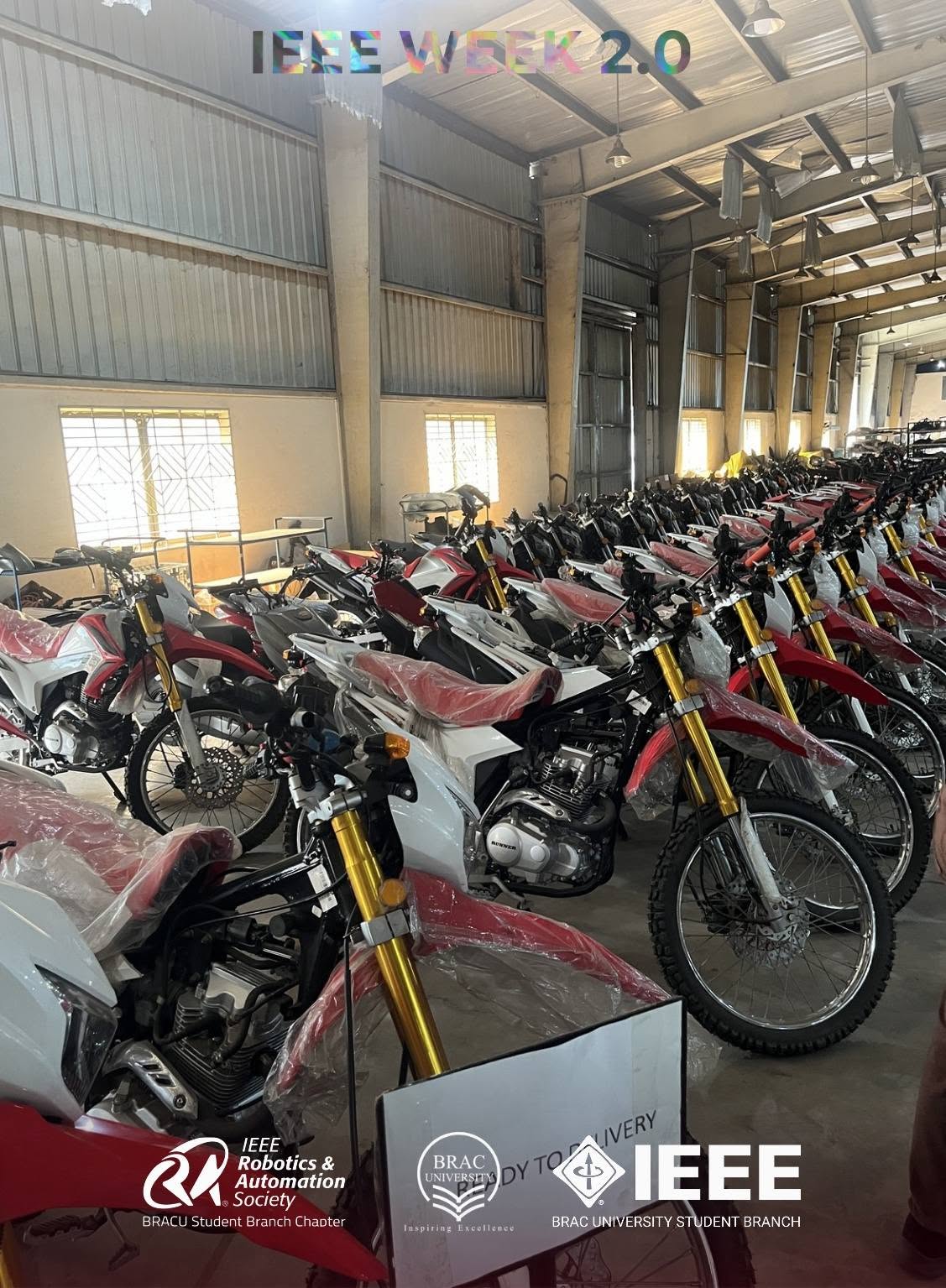
After that, we visited the area where the finished goods (FG) were stored. Compared to the other
sections, this place felt relatively colder, which made the environment noticeably different.
There were many electric vehicles (EVs) stored there. An expert in charge of that section answered
all the questions the participants had regarding EVs. This turned into one of the most informative
parts of the visit.
We learned that the EVs mainly use two types of batteries:
- Lithium battery
- Graphene battery
We were told that the charging time is approximately 4 hours. We also saw some Yadea, Aprilia,
Vespa, and many more companies’ vehicles in that section. One very practical and interesting
comparison shared with us was that with around 10 taka worth of electricity, one of the EVs could
travel nearly 80 kilometers, which highlighted the cost efficiency of electric vehicles.
The expert also mentioned the E8S200 model and explained how vehicle performance and mileage
are tested. According to him, there are mainly two types of testing used:
- Smooth driving or brake-less testing
- Real traffic testing
After completing these tests, the final tested mileage is determined. During the discussion on EV
ecosystem development, he also mentioned that Farhan Khalil Sir was working with a team from
RUET on charging station-related work.
Three-Wheeler Production Section
After observing the 2-wheeler and EV sections, we went to the 3-wheeler production section. There,
MD Abdul Kamal Azad Sir joined us and walked us through the complete process behind the
production of 3-wheelers.
He informed us that the factory currently produces around 60 to 70 CNG 3-wheelers per day, while
the total production capacity of the factory is around 120 CNGs per day.
An important point we learned in this section was that for 3-wheelers, the parts do not come as raw
materials. Instead, they arrive as CKD parts, and the body parts are then assembled inside the factory.
This gave us a practical understanding of how semi-knocked-down components are used in industrial
manufacturing.
Three-Wheeler Welding Line
In the 3-wheeler welding section, there were two separate lines:
- 3-wheeler body welding line
- 3-wheeler chassis welding line
The chassis line had three robotic cells and an IG gun cell, which reflected the factory’s use of
automation and precision tools within the production process.
MD Abdul Kamal Azad Sir also explained some mechanical and technical aspects of welding. He told
us that the factory uses resistance welding machines for welding materials within the range of 0.75
mm to 2.5 mm. He further explained that depending on the nature of the work, the gun structure is
designed or modified accordingly.
While moving through this section, we also saw the CMM machine. We learned that in this machine,
3D drawings are compared with the body line welding output, and then the tolerance level of the
body is checked. This was an important observation because it showed how the company ensures
dimensional accuracy and quality consistency.
Paint Shop
We then visited the paint shop, which was one of the most organized and controlled environments
inside the factory. The process flow in this section was explained step by step. The workflow
included:
- Loading Point: The initial stage where raw metal bodies are securely mounted onto the conveyor system to begin their journey.
- PTCED Line: A combined sequence of chemical pre-treatment (cleaning) and Cathodic Electro-Deposition to prep the metal for painting.
- CED Coating: An electrochemical dipping process that applies a uniform, rust-resistant base layer to every crevice of the body.
- Sanding Booth: A precision station where technicians smooth out minor surface imperfections to ensure a perfectly flat foundation.
- Tag Bag for Final Coat: A specialized cleaning step (often involving “tack rags”) to remove microscopic dust particles just before the color is applied.
- Top Coat: The final application of pigment and clear coat that provides the vehicle’s aesthetic color, depth, and UV protection.
- Drying Station: A high-temperature curing oven where the paint layers are baked to harden and permanently bond to the surface.
- Inspection Booth: A high-intensity lighting zone where specialists scrutinize the finish for runs, dust nibs, or color inconsistencies.
- Quality Control Board: A visual management hub that tracks real-time production data, defect rates, and process efficiency.
This section was a highly temperature-controlled environment, which showed how sensitive and
quality-dependent the paint process is. The structured workflow of the paint shop gave us a clear
understanding of how finishing quality is maintained in industrial production.
Engine Assembly and Testing
Later, we also observed the engine assembly workflow. In this area, we learned that after the engine
assembly is completed, it goes through QC testing, and after that, the engine is sent to the general
assembly section.
There was also a dyno test area, which added to our understanding of how engine performance
testing is done before final integration.
General Observation on Workplace Management
One of the most striking things throughout the visit was the consistency of workplace management. In
every shop, we observed:
- Quality and defect analysis boards
- TPM boards
- Safety boards
- 5S workplace boards
This reflected the company’s commitment to workplace discipline, safety standards, efficiency,
productivity, and quality assurance. For students like us, this was a very meaningful learning point
because it showed that industrial success depends not only on machines and technology, but also on
systems, management, and proper workplace culture.
Lunch and Q&A Session
After the factory observation ended, we returned to the facility. After freshening up, we went for
lunch. Following lunch, a Q&A session was arranged, where the participants got the opportunity to
ask various questions regarding production, electric vehicles, factory operations, quality control, and
industrial practices.
This session was very interactive and helpful, because it allowed us to clear our doubts and gain
deeper insight directly from industry professionals. During the session, the hosts also provided us with
more snacks and souvenirs, which added a warm and thoughtful touch to the overall experience.
At the end of the session, we, from our side, presented souvenirs to the industry head and the
individuals who had supported and guided us throughout the day. This was a small token of gratitude
for their hospitality, time, and effort.
Closing of the Visit
After the Q&A session, we had another round of photography to capture the memorable moments of
the day. Finally, we left the factory premises at 5:00 PM, bringing an end to a very informative,
engaging, and enjoyable visit.
Conclusion
The industry visit to Runner Automobiles PLC Manufacturing Plant was an extremely enriching
experience for all of us. Even though the full production process was not active on that day due to
material shortage, the visit still offered us detailed exposure to the company’s industrial environment,
manufacturing sections, quality assurance processes, and workplace systems.
From pressing, welding, assembly, EV storage, 3-wheeler production, and paint shop operations to
engine assembly and testing, every part of the visit gave us practical insight that cannot be gained
from classroom learning alone. The guidance from the officials, the support from the assigned guides,
and the friendliness shown by the organization made the visit even more meaningful.
Overall, this industry visit successfully bridged academic knowledge with real industrial practice and
gave the participants a valuable opportunity to learn from a leading automobile manufacturing
company in Bangladesh.